Dave's Shaves Frequently Asked Questions
What is the difference between a wooden spokeshave and a metal spokeshave?
The fundamental difference between a wooden spokeshave and a metal spokeshave is the angle at which they present their cutting edges to the work piece. Blades are set (or bedded) in these tools at a fixed angle. The bed angle is defined as the angle that the blade's "face" (the side opposite the bevel) creates relative to the sole of the tool.
Metal spokeshaves appeared in the mid-1800's following the advent of the cast metal bench plane. Most makers of these bench planes also offered spokeshaves. These metal spokeshaves had bed angles approaching that of metal bench planes. Some consider the metal shave to be a cousin to the metal bench plane because of this higher bed angle and that it's short sole extends both ahead and behind it's blade.Original wooden spokeshaves would be more correctly termed low angle spokeshaves. These appeared on the tool time-line ahead of cast metal spokeshaves by at least a century but specific dates are obscure. In contrast to the metal shaves, the wooden shave has a low bed angle that approaches a paring chisel or drawknife in use, and has a sole only ahead of its blade. The single sole helps control and regulate the cut. Together, these two features give the low angle wooden shave its unique ability to whittle shavings and excel at shaving end grain.
Which spokeshave do I choose?
I currently make three spokeshave models. These are classified by the configuration of their soles: the flat sole and compass (rounded) sole. Because the shape of the sole determines the utility of the shave, first consider the task the shave will need to perform. Please note that my recommendations for shave selection are directed toward Windsor chairmakers, but these tools are not limited to this use. Nearly all other woodworking trades and disciplines have used spokeshaves at some time in their history.
What is the difference between a flatsole and compass shave?
The terms I use below for classifying spokeshave soles are not historical terms, but were devised for my own convention. The "old guys" may not have used these terms, however they do accurately describe the tools.
The flat sole shave is the most commonly used wooden spokeshave. As the name implies, the sole is flat. Shaves of this type are seen with a plain wood sole or with a brass wear plate fitted to the sole. This shave is used for working straight, convex or moderately concave edges.
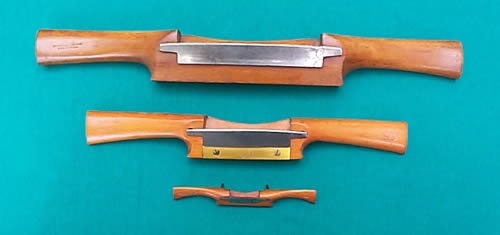
Original flatsole spokeshaves
The compass shave is a specialized tool. The sole of the compass shave is rounded to gain access into concave edges too curved for the flat sole shave. Note that the compass shave's sole is rounded in the front-to-back direction for the purpose of hollowing edges, and should not be confused with the side-to-side curvature of a travisher (a cousin to the spokeshave) which hollows surfaces. Early compass shaves had plain soles and do not appear to be brassed by their makers.
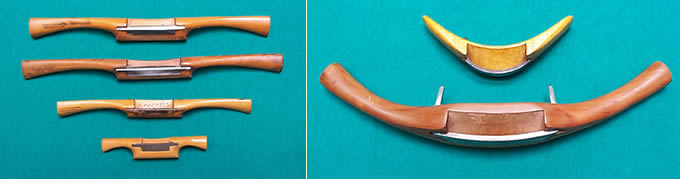
Original compass spokeshave (left) and Travishers (right).
I am taking a class on how to make a Windsor chair. Which spokeshave will I need?
A general purpose spokeshave, such as the flat sole shave, is the best choice for making a Windsor chair. It will handle all the shaving tasks required for an oval seat Windsor chair. It will also handle the majority of shaving tasks required on shield seat Windsor chairs. It is the only one needed for hand shaped spindles.
Shield seat Windsor chairs have concave anatomical details on their sides that are difficult to access with the flat sole shave. These areas can be easily shaped with specialized spokeshaves like the compass shave. The large compass shave (No.2) is best used on large or moderate radii and the small compass shave (No.0) for the tight radii or detail work.
I am taking a class on how to make cabriole legs. Which spokeshave will I need?
A compass shave can be used to perform the entire task of shaping these legs. However, you may have use for both the flat sole shave as well, since the cabriole leg has both convex and concave areas to shape. For the tightest of inside curves, the small compass shave (No.0) shave would be recommended.
Are all your spokeshaves in stock?
I try to keep a small inventory of shaves on hand, but more often the case, I make them to order. If you plan to attend a woodworking class that requires a spokeshave or wish to purchase one as a gift, please note that a lead time is needed. Allow two to four weeks from my receipt of your order to its shipping date. Occasionally, I will need to ship directly to the class if time is tight. Please note that times will vary depending on existing orders. Please inquire if you have questions on availability or special requests.